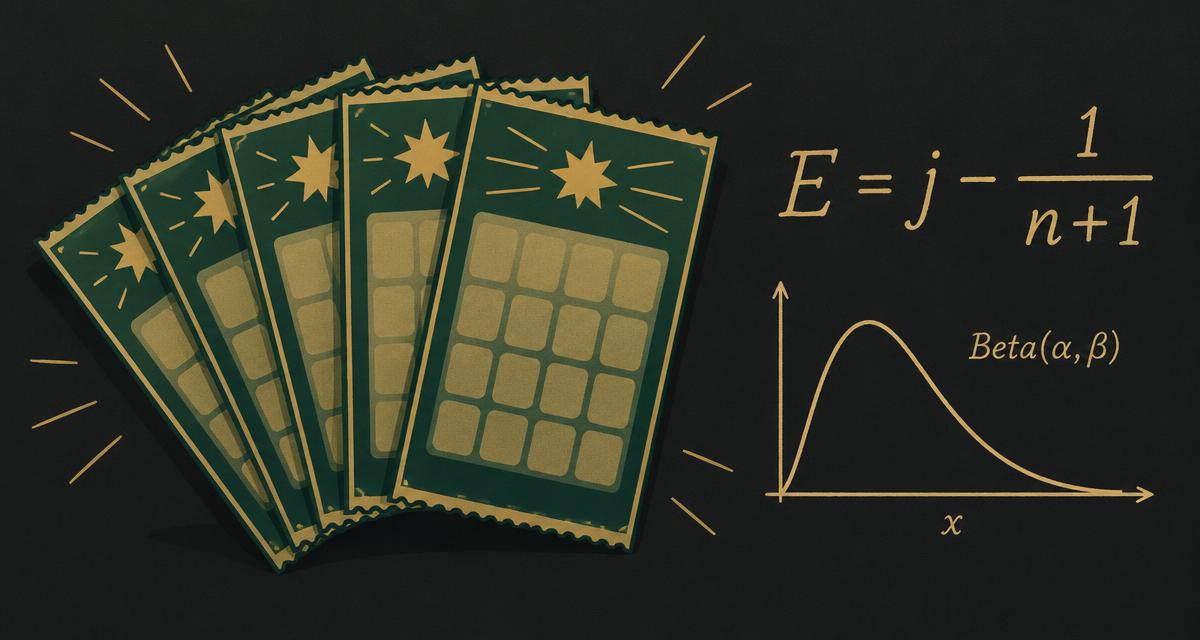
On the Simulation page, every game carries a Garibaldi Net figure and a green-or-red flag on the test 1/j < n + 1. That test comes from a real piece of published mathematics: Skip Garibaldi’s paper “The Luckiest Strategy on Earth? A Better Way to Buy Lottery Scratch-off Tickets,” in The College Mathematics Journal, Vol. 55, No. 2 (2024), pp. 117–125 (free copy on the author’s site). This article walks through what the paper actually says, in plain language, and how we apply it.
Where the formula comes from
In 2011, Harper’s profiled Joan Ginther of Texas, who claimed four multi-million-dollar lottery prizes between 1993 and 2010 — three of them on scratch-offs. Journalist Peter Mucha spent years reconstructing how she might have done it for the Philadelphia Inquirer and conjectured a specific method: use the lottery’s own published data on remaining prizes, and buy tickets one at a time, stopping the moment a large prize appears, rather than trying to buy every remaining ticket in the game.
Garibaldi — a mathematician and lottery researcher — took that conjecture and proved it. His verdict on Mucha’s claim: “He is right.” Theorem 2 of the paper is the precise statement of how much better the stop-at-the-first-large-prize strategy is, and the condition under which it actually makes money.
The setup: everything measured in units
The paper’s first move is to strip away details that don’t matter. Imagine buying every remaining ticket in a game and keeping all the small prizes but missing the large ones. In a real game, that ends in a loss. The paper calls that guaranteed loss 1 unit. Everything else is measured against it:
- j — the value of a large prize, in units. A prize worth about as much as the total small-prize shortfall is j = 1; most large prizes are worth less than that, so j is typically a number less than 1.
- n — the number of large prizes remaining.
With that notation, the basic strategy — buying all remaining tickets and claiming everything — nets nj − 1 units: you collect all n large prizes (worth nj) but absorb the 1-unit loss from everything else. The condition nj > 1 is what makes buying out a game potentially profitable. The elegant part is what vanished from the problem: the ticket price, the number of tickets remaining, and the values of every small prize are all folded into the unit.
The better strategy: stop at the first large prize
The better strategy is Mucha’s: buy tickets one at a time until you either win a large prize or run out of money — whichever comes first. Picture the unsold tickets as a giant stack, and let X be how far down that stack the first large prize sits: X = 0 if it is the very next ticket, X = 1 if it is the very last. Under this strategy you spend X and win j, netting j − X.
You don’t know X, but you know its average. The first large prize is the earliest of n randomly placed prizes, and the minimum of n uniformly random positions has expected value 1/(n + 1) — a result Garibaldi derives by noting that this minimum follows a Beta(1, n) distribution. That gives the paper’s central result:
Theorem 2. The better strategy is expected to net j − 1/(n + 1). In particular, it has a positive expected net if and only if 1/j < n + 1.
The intuition for the average cost of 1/(n + 1): with one large prize left, on average you find it halfway down the stack (spending 1/2, as the paper’s Example 1 works out). With more large prizes in the stack, the first one arrives sooner — 1/(n + 1) of the way down on average, and the more prizes remain, the cheaper your average winning ticket.
Why the better strategy is always better
Restated as a rate of return, the comparison is stark. Buying everything wins nj at a cost of 1, a rate of return of nj. Stopping at the first large prize wins j at an average cost of 1/(n + 1), a rate of return of (n + 1)j. Since (n + 1)j is greater than nj for every n and j, the better strategy dominates unconditionally. It wins the same prize while buying — on average — a strictly smaller slice of the game.
It works again the second time
A neat corollary: if other players have already bought a fraction F of the tickets, the strategy can be run again on what’s left. The paper shows the expected net is positive in that round if and only if nj > 1 − F, with a simple sufficient condition: if F ≥ j, a second pass is +EV. This is why a game whose biggest prizes are still unclaimed becomes progressively more interesting as the roll sells down — the same idea behind our top-prize-claimed warnings, read in reverse.
The fine print the paper itself flags
- Unclaimed is not the same as unbought. Published remaining-prize counts are an upper bound on n — some winners haven’t claimed yet, so n may be smaller than the lottery’s table suggests.
- Taxes. A large prize pays out smaller after tax, so the real j is somewhat lower than the advertised one.
- Budget. Most people can’t buy unlimited tickets. The paper analyzes committing only a fraction f of the remaining tickets and shows the expected net dips negative in the middle range before recovering to j − 1/(n + 1) at f = 1 — a thin bankroll undercuts the strategy.
- Scope. Theorem 2 is proved for large prizes only. The paper’s own examples use a single dominant prize tier.
How ScratcherStats applies the formula
Our Simulation page computes the theorem per game, with one deliberate extension: instead of only large prizes, n is every unclaimed prize in the game and T is the number of tickets still unsold, so any money won counts. For each game the Garibaldi card shows:
- Expected tickets to a win — (T + 1)/(n + 1), the average number of tickets you’d buy before the first win under the stopping rule.
- Cost of those tickets — that count times the ticket price.
- Expected net per win — the average remaining prize minus that cost: the game’s version of j − 1/(n + 1).
- 1/j vs n + 1 — the paper’s test, green when the expected net is positive, red when it isn’t.
We also restate the measure for cluster buying, since that is what the rest of the simulation models. The per-ticket edge e (average remaining prize per ticket minus ticket price) scales linearly: a cluster of k tickets has expected net k × e, directly comparable to the simulated Final Tally, alongside the chance the cluster contains any win. Sizing the cluster changes the magnitude and the variance — it never flips a green game to red or a red game to green.
What the formula does not promise
A green flag is rare, and when it appears the edge is thin — a few cents per ticket at best once the paper’s caveats (unclaimed-versus-unbought, taxes) are priced in. Lotteries design every game to return 60–70% of sales as prizes; most games, most of the time, fail the 1/j < n + 1 test, exactly as intended. The formula is a tool for ranking the games in front of you and knowing when the published numbers say a game is unusually favorable — not a promise of profit.
Scratch-offs are entertainment with a known cost. Play only with money you are prepared to lose, and if gambling stops being fun, call the National Problem Gambling Helpline at 1-800-522-4700.